
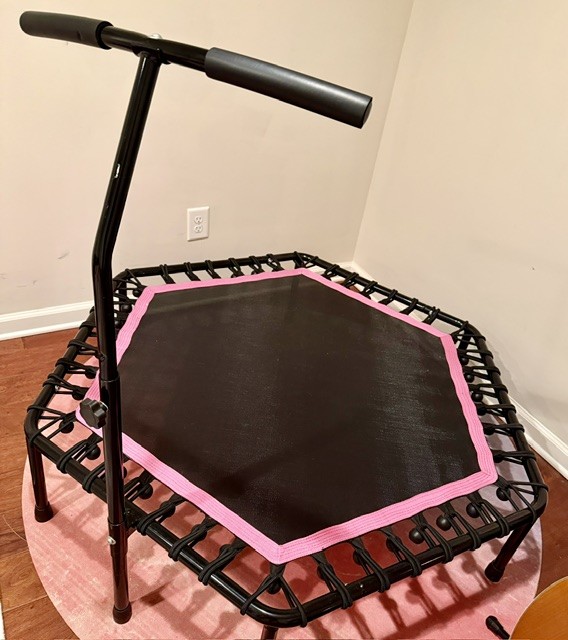
Back in the day, early 2000’s I belonged to Crunch gym in Roswell, Georgia. Every so often the cardio teacher would take out the rebounder and we would jump for a while. It was never more than fun for me, I never really thought about getting one for my home.
At my church, Restoration Church in Alpharetta, Georgia, they had a Wednesday night series on Health. A woman on the panel, the Anti Cancer mom came and told her story. She was given only a few months to live and instead of taking the traditional chemo route, she was healed from cancer from food, prayer, and REBOUNDING. One of her hacks to living a healthy cancer-free life is Rebounding. Here is her article on her blog about her rebounding.
Crazy, jumping to detox your body?! What does jumping do to detox your body? Well without getting too scientific, it basically opens your lymphatic drainage in your body and promotes fluid circulation and cell waste removal.
But that is not all, I also jump to make my knees, hips and back feel better.
Why Is the Rebounder good for me knees? Even Arthritis Knees?
From experience I can tell you Rebounding did strengthen my knees, but what is the research?
-
Biomechanical Shock Distribution (NASA Study): The foundational study by Bhattacharya et al. (1980) measured gravitational impact forces and oxygen uptake during treadmill running versus trampoline jumping. The researchers found that while running produces sharp, localized peak accelerations at the lower limbs (ankles and knees), rebounding distributes deceleration forces far more evenly throughout the body, providing high cardiovascular stimulus with significantly less localized impact stress.
-
Lower-Limb Alignment and Joint Loading: Akasaka et al. (2017) compared lower-extremity kinetics and kinematics between trampoline jumping and hard-surface landings using 3D motion analysis. The study demonstrated that trampoline jumping alters joint loading mechanics favorably, engaging knee extensor moments without the jarring impact shock observed on rigid surfaces.
-
Neuromuscular Control and Joint Stiffness: Research by Di Rocco et al. (2023) investigated the effects of mini-trampoline exercise on lower-limb stiffness and power output, highlighting that elastic surfaces allow efficient stretch-shortening cycles while minimizing excessive, repetitive load on passive knee structures.
-
Clinical Rehabilitation Applications: A scoping review by Rathi et al. (2024) evaluated rebound exercise across rehabilitation settings, noting that compliant mini-trampoline surfaces significantly attenuate cumulative impact trauma, making them effective for building lower-limb strength, proprioception, and functional mobility in joint-sensitive populations.
Why is the Rebounder good for my back?
When I had a back injury due to gardening, I did not stop rebounding, in fact I rebounded more. And yes, it did make my back feel better. But what is the evidence for this:
-
Trunk Muscle Strength & Extension (German Journal of Sports Medicine): A study by Heitkamp et al. evaluated the effects of an 8-week standardized mini-trampoline training program. The researchers found that regular rebounding produced significant increases in isometric maximum strength for trunk extension (the deep back muscles that stabilize the spine) while maintaining a gentle joint profile.
-
Postural Control and Unstable Surface Core Engagement: Research in the Journal of Physical Therapy Science (Aragão et al.) demonstrated that mini-trampoline training effectively stimulates the neuromuscular system and improves dynamic balance and postural recovery. The unstable elastic surface forces involuntary micro-contractions across the core and paraspinal stabilizers to keep the torso upright.
-
Rebound Therapy in Neuromuscular and Spinal Rehabilitation: A study published in PMC/Rehabilitation Research (Ghasemi et al., 2024) explored rebound therapy’s effect on trunk and hip control. The findings noted that the elastic surface creates continuous reflex activations in deep core muscles (such as the transversus abdominis and quadratus lumborum), which support pelvic control and take mechanical pressure off the lumbar region.
-
Biomechanical Shock Dissipation on the Axial Skeleton (NASA): The classic study by Bhattacharya et al. (Journal of Applied Physiology) measured gravitational force distribution during running versus trampoline jumping. They found that jumping on a compliant surface avoids the high peak impact accelerations transmitted through the skeletal frame on hard ground, reducing vertical compressive shock along the spinal column.
Why is the Rebounder good for my Hips?
As I age, I do struggle with hip pain. And yes, the Rebounder helps with my hip pain. I know crazy! But why does it help hips? Here are some key studies:
-
Femoral Neck Bone Density & Lower-Limb Strength: A randomized controlled trial published in Clinical Interventions in Aging (Posch et al., 2019) evaluated a 12-week mini-trampoline training program in older women with osteopenia. The intervention group demonstrated significant improvements in femoral neck bone mineral density (BMD) (+2%), lower-limb strength on the 30-second chair stand test (+36%), single-leg balance (+33%), and dynamic functional mobility (Timed Up and Go test).
-
Pelvic Stabilization & Neuromuscular Reflexes: Research in Gait & Posture (Aragão et al., 2011) investigated the neuromuscular effects of mini-trampoline exercise on balance and stability. The compliant, unstable surface challenges sensory feedback, stimulating rapid co-activation of hip abductors (like the gluteus medius) and deep pelvic stabilizers to correct center-of-mass shifts and stabilize the hip during gait.
-
Lower-Limb Rehabilitation & Impact Attenuation: A comprehensive scoping review by Rathi et al. (2024) in Cureus examined the therapeutic applications of rebound exercise. The authors noted that the elastic deceleration profile mitigates peak cumulative joint stress, enabling safe improvements in lower-limb strength, proprioception, and functional mobility without aggravating degenerative joint pain.
-
Biomechanical Joint Shock Distribution: The foundational NASA study by Bhattacharya et al. (1980) in the Journal of Applied Physiology compared impact forces between running on hard surfaces and trampoline exercise. They demonstrated that while running generates high, concentrated impact peaks through the lower extremities and pelvis, rebounding dissipates landing forces across the elastic bed, substantially reducing localized shock to the hips, knees, and spine.
You don’t have to make life complicated by doing a fancy workout on the rebounder. Start slow. Just small bouncing. Hold on the the handle. I also don’t bounce for long periods of time, just 3-5 minutes a day is all I really need. It is apart of my 10 minute morning routine. (17 morning exercises)
Also when you get your rebounder, put it somewhere you will use it. Somewhere you will have access to it everyday, not in a closet or up against a wall. It should be considered apart of your daily, health building life.
I did not buy a real expensive trampoline, I bought a band one, but there are also spring ones. Buy one that fits in your budget and your house with a handle. Don’t buy one without a handle, it can be dangerous.